
Table of Contents
What is Market-Research Interpreting
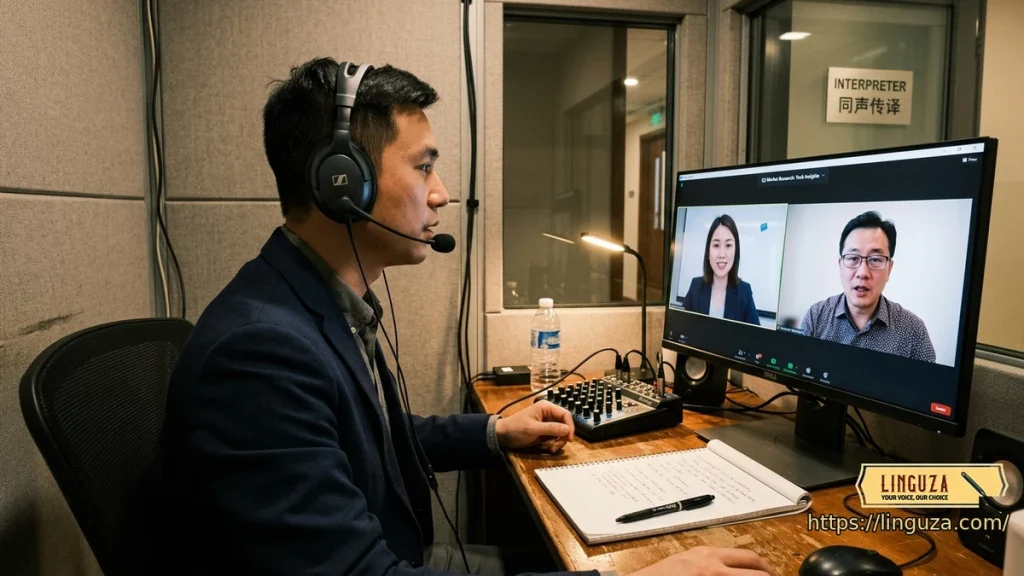
Market-research interpreting is a specialized simultaneous‑style interpreting service for qualitative research, covering both in-depth interviews and focus group moderation sessions. It differs substantially from conventional booth‑based simultaneous interpreting. Complex dual‑interpreter booth hardware is generally not required. In smaller‑scale sessions interpreters may adopt chuchotage (whispered interpreting) techniques, though most projects rely on lapel microphones or single‑channel audio set‑ups. Some research agencies even arrange a dedicated remote interpreting booth for market‑research assignments.
As a core market-research interpreter service, it falls into two primary formats: IDI (In‑Depth Interview) interpreting handled by an IDI interpreter for one‑on‑one respondent sessions, and focus‑group work delivered by a focus‑group interpreter for multi‑participant group discussions, where the interpreter works alongside the moderator throughout the session. Both varieties belong to the broader family of interview interpreter services. Note that people frequently mix‑up terminology and search for “IDI translator” or “focus‑group translator”, yet this live spoken‑language work requires an interpreter, not a document translator whether the session involves one-on-one interviews or group moderation.
Why Native‑Language Interviews Produce Better Research Data
Here’s the detail that surprises a lot of first‑time research clients: even though both moderators and respondents speak fluent English, discussions are still conducted in the participants’ native language— not English. Native‑language expression is more accurate, more emotionally genuine, and simply allows people to articulate real, in‑depth opinions in ways that second‑language speech cannot. Hedged, oversimplified answers delivered in English are a poor substitute for the nuance that comes naturally when participants speak in Mandarin or Cantonese.
This is precisely why professional market‑research interpreters remain necessary even when all parties can converse comfortably in English. The interpreter is not brought in because participants lack English‑language ability; rather, research insights become far more valuable when the whole dialogue unfolds in native tongues, and respondents are spared the mental burden of self‑translating their thoughts. This priority on authentic respondent voice aligns with formal qualitative research guidelines published by ESOMAR.
How Market-Research Interpreting Works
Most IDI and focus‑group interpreting is from Chinese to English — an active, single‑direction form of interpreting. The moderator typically poses questions in Mandarin or Cantonese, and the interpreter converts the respondent’s Chinese answers into English in real‑time for the off‑site research team. Unlike standard booth‑based simultaneous interpreting, where interpreters work bidirectionally and rotate in pairs, this unidirectional market-research workflow needs no back‑translation into Chinese, so one professional interpreter can manage the full session.
Focus‑group assignments follow the same core language‑transfer logic, yet multi‑participant dialogue raises higher demands for speaker identification and processing overlapping remarks. More demanding group sessions may call for two‑interpreter resourcing.
For interpreters, pre‑session review of the full discussion guide is critical for both IDI and focus‑group assignments, helping them anticipate open‑ended, unscripted remarks from respondents.

Real-World Market‑Research Interpreting Industry Use Cases
Professional market‑research interpreter services support qualitative research across diverse industries, with tailored accuracy for different respondent groups. Focus‑group projects are also widely deployed across these same verticals.
1. Consumer Brand Research
Global consumer brands rely on IDI interviews and related focus‑group work to collect authentic local feedback on product design, packaging, branding, and marketing campaigns.
A typical use case included a pre‑Christmas project for a multinational skincare firm based in Shanghai in 2024, in which 5 local female respondents aged 35‑45 took part in IDI sessions for an upcoming anti‑ageing festive gift‑set launch. Discussions covered daily skincare routines, acceptable price points, packaging preferences, after‑sales expectations and consumer trend sentiment. Professional Mandarin‑to‑English interpreting captured nuanced user opinions for the overseas product team.
2. Pharmaceutical & Healthcare Research
Growing cross‑border collaboration among global pharmaceutical companies has driven rising demand for specialized market‑research interpreting within the healthcare sector. A single research initiative may target both medical practitioners and patients, requiring distinct interpreting approaches for each respondent group.
When working with physicians, pharmaceutical interpreters and medical interpreters navigate highly technical subject‑matter, including views on clinical trial design, mechanism of action (MoA), safety and efficacy profiles, and feedback on pre‑launch product concepts. Discussions often cover clinical‑strategy topics such as first‑line and second‑line treatment pathways, combination‑therapy considerations, and suitable patient populations for new‑drug candidates.
Patient‑focused sessions call for more accessible, empathetic delivery from healthcare interpreters (and occasionally community interpreters). Respondents may complete assessment scale instruments prior to interviews, then share lived‑experience feedback covering pain levels, recovery trajectories, and willingness to participate in clinical trials. Conversations can touch on perceptions of assignment to placebo groups, study groups or control groups, all of which must be faithfully rendered to deliver authentic, patient‑centric data for regional product adaptation and clinical‑report development. Focus‑group formats are also deployed for peer‑to‑peer patient discussion research.
For instance, in 2021, a Swiss pharmaceutical firm developing a new anti‑platelet drug conducted market‑research interviews with haematology physicians and patients across hospitals in Beijing. The Chinese medical interpreter needed to accurately relay specialist clinical feedback from doctors alongside real‑world patient perspectives, while handling domain‑specific terminology for this cross‑stakeholder research project.
Market‑Research Interpreting Project Settings
Beyond industry‑specific requirements, interview interpreting projects differ widely in logistical setup, project scale and delivery format — critical variables that shape interpreter deployment, session consistency and the comparability of collected research insights. These scope rules apply to both IDI and focus‑group assignments.
1. On‑Site Market‑Research Interpreting
On‑site market‑research interpreting takes place across different physical venue set‑ups for IDI and focus‑group assignments. Respondents may attend sessions at dedicated market‑research agencies or directly at the brand‑client’s premises.
At specialist research agencies, a dedicated interpreting room is often available. The on‑site interview interpreter can view respondents and moderators via screen feeds, while remaining out of sight from participants. Client‑side stakeholders receive the interpreted audio feed remotely from this interpreting room. On the other hand, when sessions are hosted directly at the brand‑client’s location, a similar interpreting-room‑based workflow may be adopted, while in some cases, interview interpreters may deliver chuchotage (whispered interpreting) for on‑site client‑side stakeholders sitting within the same meeting room .
2. Online Market‑Research Interpreting
Remote market‑research interpreting is now a well‑established delivery mode for qualitative projects. A remote interpreter provides online market‑research interpreting via Zoom, Microsoft Teams, Interprefy or Tencent Meeting for both IDI and focus‑group sessions, offering online interview interpreting for geographically scattered respondents and cutting physical‑site logistics burdens.
For example, in 2023, a UK‑based consumer‑technology firm conducted multi‑country qualitative research for its upcoming home‑entertainment VR device, recruiting participants in Shenzhen, Tokyo and Seoul. Instead of flying out its project team and interpreters to each individual city, a process that would consume significant time and budget, it engaged one interpreter in Shenzhen, one interpreter in Tokyo and one interpreter in Seoul to deliver services online. Serving as an online Chinese interpreter, an online Japanese interpreter and an online Korean interpreter, these locally‑based specialists brought consumer‑electronics domain knowledge to deliver consistent interpreting across all remote IDI sessions. This approach saves substantial time, travel expenditure and operational effort for the client. After reviewing the discussion guide, online market‑research interpreters handle everything from general consumer commentary to highly specialised technical terminology, unlocking access to participant groups that would otherwise be logistically difficult to cover.
Common Questions on Market‑Research Interpreting
What is the core difference between IDI and focus‑group interpreting?
Does market‑research interpreting ever go both directions, English to Chinese as well?
If moderators and respondents speak the same language but external stakeholders require interpreting, only one‑way interpreting applies: content flows from the participants’ native language to the stakeholders’ working language.
Can one interpreter handle multiple interview rounds in the same project?
Is market‑research interpreting only used for Mandarin?
Ready To Arrange Your Market‑Research Interpreting?
Planning market‑research work requiring IDI or focus‑group interpreting with Mandarin or Cantonese‑speaking respondents? Contact Linguza and we’ll match you with an interpreter experienced in your research area.
Leave a Reply